![3_Transparent_Image_footer.png]](https://novineer.com/hs-fs/hubfs/3_Transparent_Image_footer.png?height=32&name=3_Transparent_Image_footer.png)
NoviPath provides standard restraints: Fixed (all 6 DOFs constrained), Pinned (translations fixed, rotations free), and Sliding (one translation free, rotations free). You can also choose Custom and set each DOF to fixed or free.
Restraints limit how selected faces or volumes can move. In the current version of NoviPath, the built-in types use tray (global) X, Y, and Z — not the local face normal.
| Type | Translations | Rotations | Typical use | |
|---|---|---|---|---|
| Fixed | UX, UY, UZ held | RX, RY, RZ held | Fully clamped support: bolt pattern, welded base, “built-in” end. Use when the region should not move or rotate. | |
| Pinned | UX, UY, UZ held | Free | Ball joint / hinge-like support: location fixed, but the part can rotate. Common for simple supports and pivot mounts. | |
| Slide | One of UX / UY / UZ free; the other two held fixed | Free | Linear guide or roller in a tray axis (choose free X, Y, or Z). Use when motion should only be allowed along a global direction — e.g. free along tray Z on a horizontal face. Does not follow a tilted face normal. | |
| Custom | Per-DOF | Per-DOF | Anything that is not Fixed, Pinned, or Slide (global) — e.g. free UX+UY only, or fix rotations without fixing all translations. |
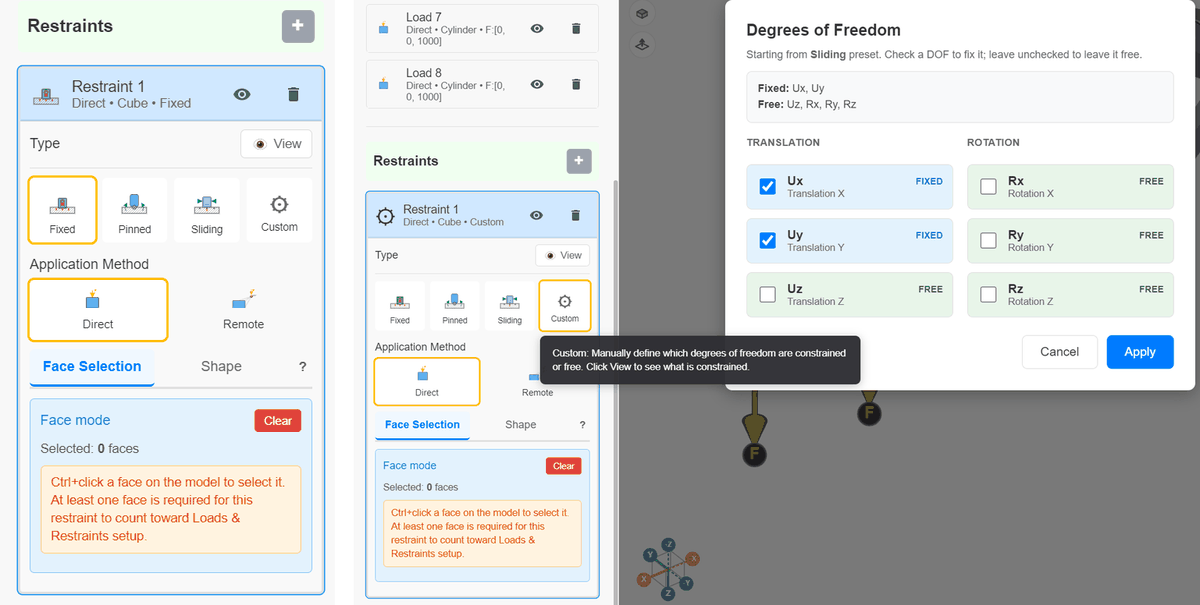
Left: standard restraints. Right: custom restraints.
Never place a restraint on faces that already carry a load in the load direction: the result is all zero. See Why are my simulation results all zero (all blue)? and, when a fixture must hold the loaded region, Load constraints.